

Used EV battery health: what the data says and how to check it before you buy
How to verify battery state of health on a used EV: SoH readouts, warranty transfer, a worked pence-per-mile comparison, and when to walk away.

The fleet data says the battery is very likely fine. A five-minute readout makes it a fact.
Average battery health across the used EV fleet
Median usable capacity at 8–9 years old
Certified EVs build buyer confidence and sell faster
The main takeaway
Most used EV batteries retain strong capacity. The risk is not that every used EV has a failing battery; it is paying full price for a car whose battery condition has not been verified.
The perception gap
Surveys through 2025–26 found very low buyer confidence in used EVs, with battery wear the biggest fear. The measured data says otherwise. The UK's largest independent study found average battery health of roughly 95% across the used fleet, and median usable capacity of around 85% in cars eight to nine years old. On that evidence, degradation is not a systemic risk.
The gap between perception and measurement is an opportunity for a buyer who can verify the specific car in front of them. Battery health certificates materially raise buyer confidence, and certified used EVs sell faster.
What state of health (SoH) means
SoH is the battery's current usable capacity as a percentage of what it held when new. It maps directly onto range and the battery is the most expensive component in the car.
SoH is not visible from the driver's seat. It is read from the battery management system, the computer that monitors every cell group.
Why the dashboard range figure misleads
The predicted range (the “guess-o-meter”) is an estimate based on recent driving, and moves for reasons that have nothing to do with the pack.
Weather
Driving history
Calibration drift
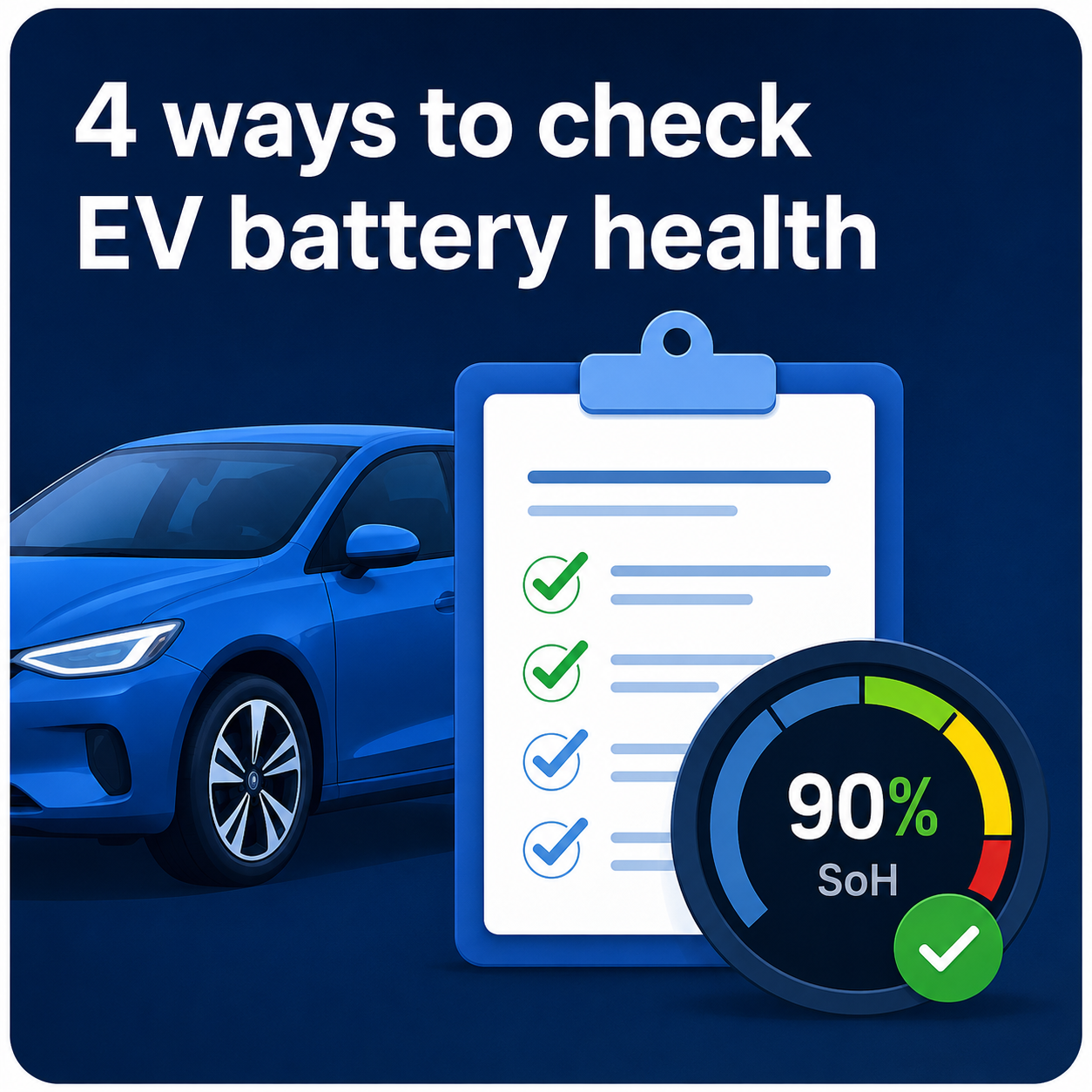
How to actually check (4 ways)
Four checks, in rising order of effort.
Manufacturer app or dealer readout
Many makers and dealers can provide SoH or a battery report. Ask for the readout in writing, with a date.
OBD dongle and an app
A cheap OBD reader and the right app pull SoH from the BMS in minutes, the same data used for certificates.
Full-charge sanity test
Test at or near 100% charge and compare indicated range with the original figure when new. Rough, but useful.
Written battery health certificate
The gold standard. Ask for a recent certificate from a named provider before you travel.
How batteries actually age
Illustrative degradation pattern
Loss is faster in the first year or two, then the curve flattens and losses slow to a crawl. A pack at the fleet median still has roughly 15 points of headroom over the warranty floor at nine years.
The warranty (typical example)
Vehicle age: 5 years
Most manufacturers warrant to around 70% capacity. Check your model for exact terms.
Running costs: real-world example
Public rapid charging: roughly 15p–22p per mile.
Comparable 45 mpg petrol car: roughly 12p per mile.
What matters less than buyers fear
- Rapid charging history. Modern packs manage charging through their own thermal and protection systems.
- The odometer alone. A high-mileage car with strong SoH evidence beats a low-mileage car with a weak readout.
What matters more
- Accident history and warranty remaining. Check for floor impacts and value every month and mile of cover.
- Equipment and paperwork. Confirm charging cables, software updates and recall work in writing.
Questions to ask the seller
When to walk away
Walk away from an older, higher-mileage EV with no SoH evidence that is priced as if it were certified. If the seller will not permit an OBD check, obtain a certificate or adjust the price, the car is asking you to carry a risk the seller refuses to quantify. The fleet data says the battery is very likely fine; a five-minute readout converts that statistical likelihood into a fact about the particular car.
How CompareForecourt handles it
CompareForecourt treats electric as a first-class fuel type. It estimates home-charging costs, flags whether the seller provides a health certificate or SoH readout, and makes missing decision-relevant evidence visible before you travel.
Compare EV listings